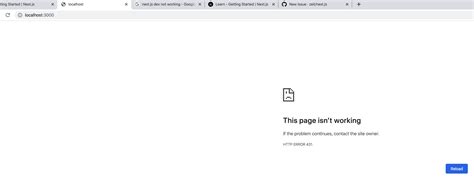
Next js localhost not working
Next.js supports generating self-signed certificates for use with local development when running . This guide will show how to use Next.js with HTTPS on .
Ensure you are on the latest version of Next.js (). If you do not already have a Next.js project created, you can get started with .
For certain features, it may be required to use HTTPS to have a secure environment on localhost. Next.js supports generated self-signed certificates for use with as follows:
This will start the Next.js development server with HTTPS enabled on .
- These self-signed certificates should only be used for local development. In production, use properly issued certificates from trusted authorities. When deploying to Vercel, HTTPS is automatically configured for your Next.js application with zero additional work.
- For specific testing scenarios, you might need to use real certificates and actual domains. This can be achieved by modifying the file to map domain names to .
Next.js has built-in support for securely running your application on with HTTPS. You can get started by running .
Unable to Fetch Data from Backend Server in Next.js SSR Production with Docker
- Frontend: Next.js
- Backend: Express.js
While using Docker and running a Next.js server, I’m unable to fetch data from the backend server during Next SSR (Server-Side Rendering) in production. This issue does not occur during SR (Server-Side Rendering) in development or when using CSR (Client-Side Rendering).
- CSR:
- Development: Fetch works
- Production: Fetch works
- SSR:
- Development: Fetch works
- Production: Fetch fails
I initially encountered errors with SSR in development when using ‘http ://localhost:8080/’ to fetch data from the backend. Using the command resulted in an error. Switching to worked, so I updated the link to ‘http ://express:8080’. However, this solution does not resolve the SSR issue in production. Fetching from ‘172.88.0.3:8080’, the backend container IP, also fails in SSR production.
Both the server and frontend work fine when accessed via a local browser at “http ://localhost:3000” and “http ://localhost:8080”. Inside the Next.js container, receives a response from the Express server.
- Error occurs only during SSR in production.
Next.js Dockerfile
Ex
How to Share a Next.js App from Localhost
Hosting your Next.js app on the internet securely without deploying to a full server is easy with Pinggy. This guide will show you how to run your Next.js application locally and expose it publicly via a secure SSH tunnel in minutes.
Summary
- Run Next.js App
- Create and set up your Next.js app:
- Create a Tunnel with Pinggy
- Start SSH tunnel:
- Access your Next.js app via the provided Pinggy public URL (e.g., ).
What Is Next.js?
Next.js is an open‑source React framework created by Vercel that streamlines building production‑ready web applications. Out of the box it provides:
- Static Site Generation (SSG) for lightning‑fast, SEO‑friendly pages
- Server‑Side Rendering (SSR) to deliver dynamic content on request
- Incremental Static Regeneration (ISR) to update static content without redeploying
- Built‑in Routing & API Routes — no extra server configuration required
- Automatic Code Splitting & Optimization for smaller bundles and faster load times
- Image & Font Optimization, Internationalization (i18n), and Analytics integrations
Whether you’re prototyping a landing page, building a full e‑commerce storefront,
Dynamic route is not found in prod. it works fine on localhost
I’m trying to migrate my portfolio website (https://meje.dev) to use the recent version of Next.js and Typescript, plus a couple of improvements on my end too.
For my blog, I’m using next-mdx-remote and node’s filesystem module to read posts from my project.
When I run the dev server locally, and I click on a PostCard to view the article, the dynamic route renders my markdown content.
When I run the build locally too, it runs quite fine and completes the entire step without errors. But when I try to access any article in production, I’m met with a 404 page. I’m very confused, because this is almost the same thing (except the typescript migration) that powers the current website
Here’s the new site: https://sev-demo.vercel.app/
I’ve also tried adding a pageExtensions property to my nextConfig, but it’s still the same.
Here’s an excerpt of what my slug route looks like:
Next.js api working on localhost but they dont work on netlify run build
Hi everyone,
I am facing an issue with my /api/* files. They work perfectly fine when I run them locally using npm run dev, and I get success responses across the board. However, when I run the build on Netlify, the site doesn’t seem to work, and I receive an internal server error when trying to use the APIs.
The site in question is https://main--relaxed-boba-dadaf1.netlify.app/. Unfortunately, accessing the parts would be blocked without a login, so you can’t test it for yourself. I have checked the code on the repository, GitHub - joshua-mcfield99/star-inn, but I couldn’t find anything useful.
One thing I noticed is that the type is XML, which is incorrect as it should be JSON. Also, the image attached to this post shows that the API files are there but have zero content.
I am new to using next/api, so I am not sure if there is anything specific I need to do, like importing the APIs into specific pages, and why the type is different on build.
Can anyone help me spot what’s wrong with my code, or suggest a fix to the issue?
Thank you in advance for your help.
How to Share a Next.js App from Localhost
Hosting your Next.js app on the internet securely without deploying to a full server is easy with Pinggy. This guide will show you how to run your Next.js application locally and expose it publicly via a secure SSH tunnel in minutes.
Summary
- Run Next.js App
- Create and set up your Next.js app:
- Create a Tunnel with Pinggy
- Start SSH tunnel:
- Access your Next.js app via the provided Pinggy public URL (e.g., ).
What Is Next.js?
Next.js is an open‑source React framework created by Vercel that streamlines building production‑ready web applications. Out of the box it provides:
- Static Site Generation (SSG) for lightning‑fast, SEO‑friendly pages
- Server‑Side Rendering (SSR) to deliver dynamic content on request
- Incremental Static Regeneration (ISR) to update static content without redeploying
- Built‑in Routing & API Routes — no extra server configuration required
- Automatic Code Splitting & Optimization for smaller bundles and faster load times
- Image & Font Optimization, Internationalization (i18n), and Analytics integrations
Whether you’re prototyping a landing page, building a full e‑commerce storefront,
Dynamic route is not found in prod. it works fine on localhost
I’m trying to migrate my portfolio website (https://meje.dev) to use the recent version of Next.js and Typescript, plus a couple of improvements on my end too.
For my blog, I’m using next-mdx-remote and node’s filesystem module to read posts from my project.
When I run the dev server locally, and I click on a PostCard to view the article, the dynamic route renders my markdown content.
When I run the build locally too, it runs quite fine and completes the entire step without errors. But when I try to access any article in production, I’m met with a 404 page. I’m very confused, because this is almost the same thing (except the typescript migration) that powers the current website
Here’s the new site: https://sev-demo.vercel.app/
I’ve also tried adding a pageExtensions property to my nextConfig, but it’s still the same.
Here’s an excerpt of what my slug route looks like:
Next.js api working on localhost but they dont work on netlify run build
Hi everyone,
I am facing an issue with my /api/* files. They work perfectly fine when I run them locally using npm run dev, and I get success responses across the board. However, when I run the build on Netlify, the site doesn’t seem to work, and I receive an internal server error when trying to use the APIs.
The site in question is https://main--relaxed-boba-dadaf1.netlify.app/. Unfortunately, accessing the parts would be blocked without a login, so you can’t test it for yourself. I have checked the code on the repository, GitHub - joshua-mcfield99/star-inn, but I couldn’t find anything useful.
One thing I noticed is that the type is XML, which is incorrect as it should be JSON. Also, the image attached to this post shows that the API files are there but have zero content.
I am new to using next/api, so I am not sure if there is anything specific I need to do, like importing the APIs into specific pages, and why the type is different on build.
Can anyone help me spot what’s wrong with my code, or suggest a fix to the issue?
Thank you in advance for your help.